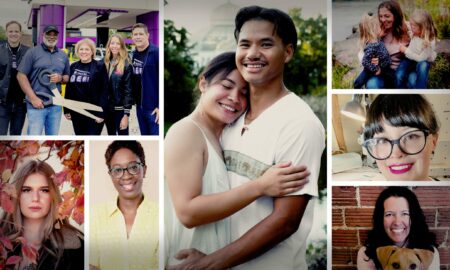





We recently had the chance to connect with Julie Zaruba Fountaine and have shared our conversation below.
Good morning Julie , it’s such a great way to kick off the day – I think our readers will love hearing your stories, experiences and about how you think about life and work. Let’s jump right in? What do you think is misunderstood about your business?
People sometimes think Empower Possible is all about feel-good workshops or retreats, but it’s really about helping people and organizations make clearer decisions and move through change in a way that matches what they care about most. Another thing that comes up a lot is Mountain 10. Many assume it’s a mountain retreat or a hiking trip, when it’s actually a decision-making process you can use any time you’re asking, “What’s my next step?”
On the surface, Empower Possible can look like coaching, training, and retreats, but the real work is helping people pause, reflect, and choose what they want their next chapter to look like. That might mean a team getting honest about how they work together, or an individual getting clear on a change they’ve been putting off and finally deciding how to move forward.
Another misunderstanding is, Mountain 10 is often misunderstood as a trip to the mountains, but there’s no requirement to lace up hiking boots. It’s a simple, guided way to listen to your inner wisdom so you can sort through options and name your next right step. People use it when they’re at a crossroads, considering a move, a job change, or a big life transition, and want something more grounded than “winging it” but more human than a pros-and-cons list.
When people see this work as extra or “nice if we have time,” they sometimes wait until they feel stuck or burned out. In reality, taking time to reflect and decide on purpose usually saves energy, money, and stress down the road. Once people experience Empower Possible or Mountain 10, they tend to come back to the tools again and again because they see they’re not just inspirational, they’re usable in everyday life and work
Can you briefly introduce yourself and share what makes you or your brand unique?
Greetings! I’m Julie Zaruba Fountaine, and I’m the founder of Empower Possible, a consulting and training practice that helps people and organizations navigate change with more clarity, confidence, and care. My background is in change management, leadership, and wellbeing, so my work sits at the intersection of getting things done and making sure people don’t lose themselves in the process.
At Empower Possible, I partner with organizations and individuals through workshops, keynotes, coaching, and facilitated planning sessions to support sustainable, values-aligned growth, not just quick fixes. Much of my work focuses on helping people pause long enough to listen to what they truly want, and then turn that insight into simple, actionable next steps they can actually take.
One of the unique tools I use is Mountain 10, which many people assume is a mountain retreat, but is actually a decision-making process designed to help you access your inner wisdom and choose your next right step during transitions, such as career changes, moves, or leadership shifts. Right now, I’m especially excited about expanding Mountain 10 workshops and collaborations that support people at crossroads, so they feel less alone and more grounded as they make important life and work decisions.
Thanks for sharing that. Would love to go back in time and hear about how your past might have impacted who you are today. What’s a moment that really shaped how you see the world?
A moment that really shaped how I see the world isn’t just one trip, but a thread that runs through a lifetime of travel. It started with family road trips across the United States and into Canada, where I first began to notice how different places, landscapes, and communities carry their own stories and ways of living. Those early trips planted a sense of curiosity and reminded me that there are many “normal” ways to move through the world.
Studying abroad in Spain deepened that shift for me. Living in another country—not just visiting—forced me out of my comfort zone and into daily conversations where I had to listen more, adapt, and pay attention to nuance. It taught me that culture isn’t something you fully understand from a distance; you absorb it through shared meals, small misunderstandings, laughter, and the humility of not always having the right words.
More recently, traveling to places like Mexico, Costa Rica, and Iceland has continued to shape my worldview. Talking with people about their home, what they love, what worries them, what they’re proud of, gives me insight I could never get from the news or a book alone. It stretches my assumptions, challenges my comfort, and reminds me how interconnected our lives really are.
Being in these different environments, from coastlines to volcanic landscapes, also keeps me in a state of awe. The beauty of the world, the land, the people, and the creativity in how communities adapt make me really appreciate all the seemingly small things. Those experiences continually remind me that there is so much more to learn, and that approaching others with curiosity, humility, and appreciation is one of the most powerful ways to move through life.
What did suffering teach you that success never could?
Suffering taught a kind of wisdom that success alone never could. It showed where my limits were, what I would no longer tolerate, and how essential it is to set boundaries that protect my time, energy, and well-being. It made clear that saying “no” is sometimes the most honest way to say “yes” to what truly matters.
It also taught the difference between being kind and being nice. Kindness can be honest, firm, and even uncomfortable at times, while “nice” often avoids hard truths to keep the peace. Through hard seasons, kindness started to look more like telling the truth, asking for what I need, and not abandoning myself to make others more comfortable.
Suffering revealed who is really in my corner. When things fall apart, the people who stay, listen, and show up without judgment have helped me recognize real support, deepen a smaller circle of trusted people, and release relationships that were built more on convenience than on care.
It also invited me into healing, not just coping. Pain pushed me to explore therapy, reflection, spiritual practices, and tools for emotional regulation that I might not have reached for if everything had been smooth. This process showed that healing is rarely quick or linear, but it can be deeply transformative.
Most importantly, suffering taught that pain does not have to be the final word. It can be a teacher instead of a judge. Learning to ask, “What is this here to show me?” has helped turn difficult experiences into sources of strength, empathy, and clarity, being shaped by pain in a positive way rather than destroyed by it.
Sure, so let’s go deeper into your values and how you think. What are the biggest lies your industry tells itself?
One of the biggest lies in both well-being and change management is that “it’s all about the individual.” The story often sounds like: if people just tried harder, had more grit, or used the right self-care routine or mindset, everything at work and in life would fall into place. This framing quietly shifts responsibility away from communities, leaders, and systems, and onto one person who is usually already overwhelmed.
That is exactly why my work focuses on three forms of empowerment: self, social, and systems. Self-empowerment matters; developing insight, skills, and boundaries is important, and it’s only one piece. Social empowerment is about the quality of our relationships, teams, and communities: how we communicate, support one another, and share power. Systems empowerment looks at policies, structures, culture, and expectations that either support or sabotage well-being and change.
When we only work at the individual level, we end up asking people to be “resilient” inside systems that remain harmful or unsustainable. When we work at all three levels, self, social, and systems, we can create environments where people don’t have to burn out or constantly “fix” themselves just to get through the day. That’s where real, lasting change becomes possible.
Okay, we’ve made it essentially to the end. One last question before you go. Could you give everything your best, even if no one ever praised you for it?
Yes. Working as a solo entrepreneur has taught that lesson in a very real way. A lot of the work that happens behind the scenes, planning content, preparing workshops, refining processes, following up with clients, is work most people will never see or praise.
There was a time when lack of recognition felt really painful, and it became clear that tying worth to external praise was a fast track to resentment and burnout. That’s when the shift began from “I need people to notice” to “I’m responsible for the quality of what I put into the world.”
Praise is something that can’t be controlled, but effort and integrity can. The notes and messages from people who share how a workshop, training, or conversation helped them mean a great deal, and they are deeply appreciated. But the reason for giving everything the best is rooted in internal motivation and values, not in guarantees of praise.
The hard part was accepting that there will be meaningful work that is never acknowledged publicly and impact that is never fully visible. The freedom came in deciding not to chase what can’t be controlled and instead focus on what can: preparation, presence, and the care put into each person and project. The rest has to be released.
Contact Info:
- Website: https://www.empowerpossible.com/
- Instagram: https://www.instagram.com/empowerpossible/
- Linkedin: https://www.linkedin.com/in/julie-zaruba-fountaine-6b527636/
- Facebook: https://www.facebook.com/people/Empower-Possible-LLC/100086568280125/
- Youtube: https://www.youtube.com/@empowerpossible