






Today we’d like to introduce you to Phoenix Mental Health, a therapist-owned mental health cooperative in the heart of Minneapolis, Minnesota.
Can you walk us through the origins of Phoenix Mental Health and how its mission and structure have grown over time?
Phoenix Mental Health was founded in 2009 by Jeff Jones as a solo practice. By 2014, seeking to expand and move beyond the isolation of solo work, Jeff envisioned a practice that departed from traditional hierarchical business models. He sought to avoid structures that could reinforce exploitation or authoritarianism, aiming instead for a healthier work environment. Driven to find a more equitable alternative, Jeff began looking for clinicians interested in forming a psychotherapy workers’ cooperative. He met fellow therapist and musician Eric Levy, and together they began planning this new structure. By 2015, Phoenix Mental Health was fully operational as a worker-owned practice. As of 2025, we moved into our new office at Loring Corners in Minneapolis and have grown to include eight licensed, invested co-owners.
Can you talk to us a bit about the challenges and lessons you’ve learned along the way. Looking back would you say it’s been easy or smooth in retrospect?
That is a great question. While it has not always been smooth and we have experienced many growing pains, we become stronger as a collective with every obstacle we overcome. One of the most liberating yet difficult aspects of being a worker-owned cooperative is that we vote on all meaningful decisions. This can be challenging when opinions or priorities differ, and it has led to past owners leaving the practice, which is never easy. Most of us were not raised in a work culture where every voice has equal value or where judgment calls are made collectively. This requires us to navigate difficult conversations to reach a consensus, even amidst disagreement. It can feel risky for those accustomed to traditional structures to trust that their voices will truly be heard. While we play different roles, we maintain equal importance and investment in our practice. We have also faced significant external challenges,including a commitment to a five-year lease at our previous office location during the height of the pandemic in an area impacted by violence. Our community has navigated immense trauma following the deaths of Jamar Clark, Daunte Wright, and George Floyd, as well as the local impact of civil unrest and the fear caused by ICE activity. Despite these hardships, we have witnessed incredible growth and support. These experiences underscore the importance of serving our community—a community where most of us also live and are grateful to be a part of. While there have been bumps along the way, we have built the trust necessary to weather them, recognizing that healthy conflict can lead to progress.
Alright, so let’s switch gears a bit and talk business. What should we know about your work?
We are a therapist-owned cooperative located in the heart of Minneapolis, Minnesota. Our practice is unique in that all eight of our members own the business equally. With no structural hierarchy or “boss,” every clinician has an equal voice in how we practice, ensuring that no one profits off the work of others. This cooperative model is rooted in a social justice standpoint. We are deeply committed to the Minneapolis community and aspire to support those who feel oppressed by larger systems of power. We want you to know that we are here for you regardless of race, class, or gender identity. It is an honor to serve our community. Our services are strictly confidential, and we are dedicated to protecting your right to mental healthcare, no matter who you are.
Are there any important lessons you’ve learned that you can share with us?
Throughout our journey, we have continued to learn many lessons around what it means to be a cooperatively owned mental health clinic. One important lesson that comes to mind has been how to protect the sacredness of our democratic model. This has meant, how do we protect and lift up every voice in our company so that everyone feels safe and supported in our clinic. Ensuring every owner feels heard and supported is not only important for our business model, but is also crucial to ensure that we can serve the community in the best way possible, starting with ensuring that we ourselves feel safe in our created environment. We have learned that moving through a business crisis, like the ones listed above, is a more cumbersome task when many people have to agree on how to proceed in unprecedented circumstances. However, keeping the democratic model at the heart of the discussions helps us move through the conflict in a way that hopefully honors all voices, even if the outcome can’t fit with what every person was hoping for. So, the bottom line in terms of lessons learned, is that our model requires great protection and care to ensure we can all do the important work that we do.
Pricing:
We accept most major insurance plans including Medicaid and Medicare plans. If you don’t have health insurance, we can offer a sliding fee or pro bono services if the need is there. We also have self pay options and encourage potential clients to reach out to us to talk about cost as each individual’s financial situation is different and we take that into consideration to keep things affordable and accessible for everyone.
Contact Info:
- Website: https://Phoenix-mental-health.com
- Other: Admin@phoenix-mental-health.com
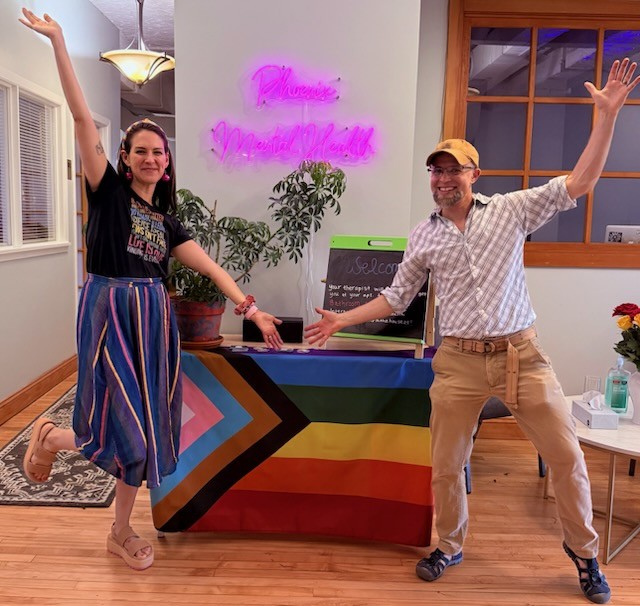
Image Credits
Group Photo taken by our property manager, Alex Heller
Alex Heller is a Minneapolis-based property manager, entrepreneur and community advocate. As part-owner and steward of the historic Loring Corners complex, Alex oversees long-term revitalization for one of the city’s most iconic mixed-use properties. He is also the co-founder of Fawkes Alley Coffee, a mission-driven nonprofit café reinvesting in youth programming through Futsal Society. Alex works at the intersection of real estate, small business development, and neighborhood revitalization — creating spaces and opportunities that strengthen the social fabric of Minneapolis.