




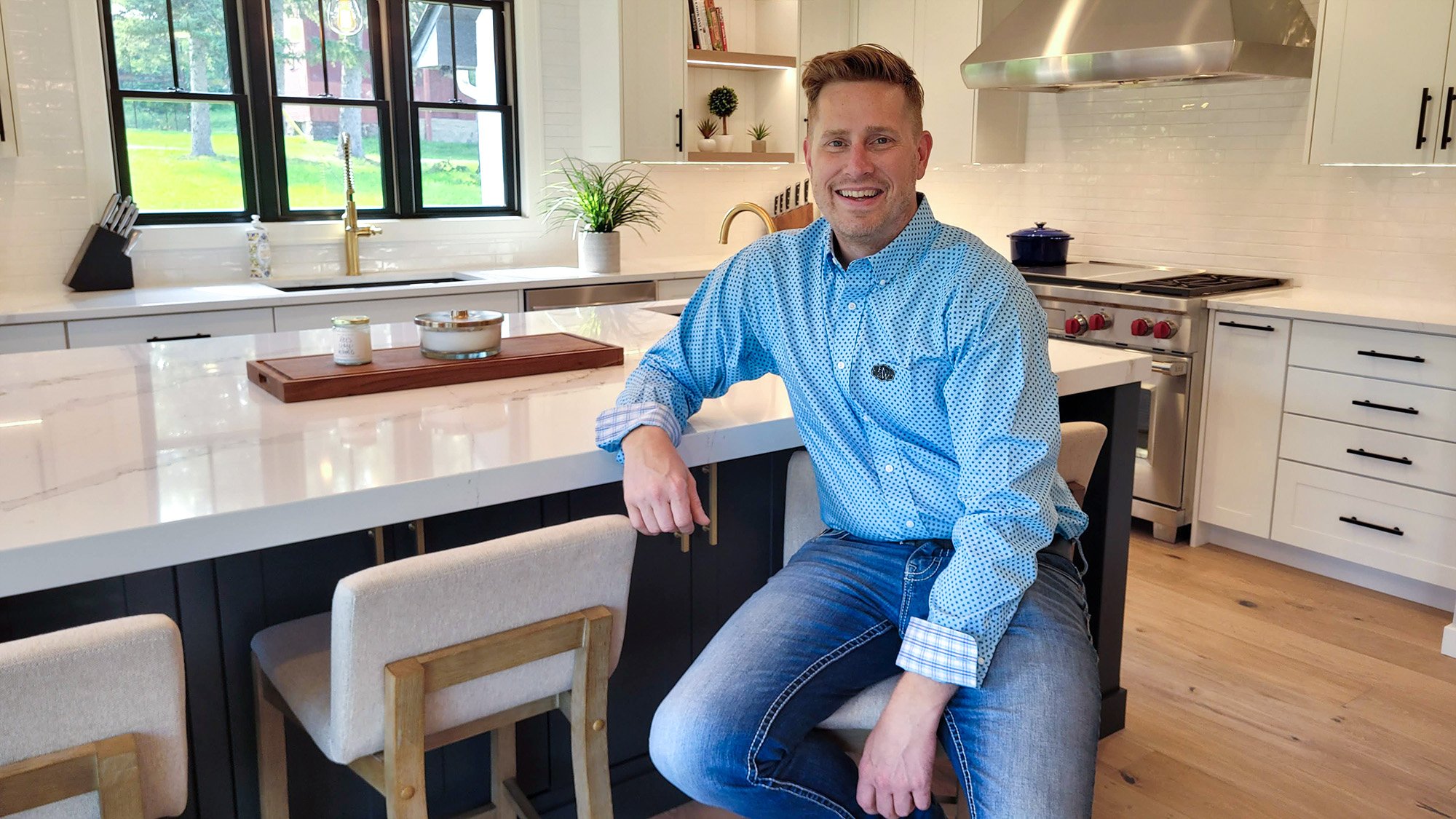
Today we’d like to introduce you to Adam Hansen.
Alright, so thank you so much for sharing your story and insight with our readers. To kick things off, can you tell us a bit about how you got started?
The Hansen & Company Story
Hansen & Company Woodworks began in 2004 out of necessity. I needed a job. I found a small space for rent in the St. Cloud area — I think it was around 2,000 square feet — and secured an $8,000 loan to purchase a table saw, a miter box, and basic hand tools. The first shop was extremely manual and hand-tool driven. I began by building fireplace surrounds for a local developer and soon asked if I could build the cabinets for some fourplex townhome units he was constructing. He gave me the opportunity and the price he normally paid.
At that time, I did not yet know how to build cabinets. I purchased flat-packed cabinet parts from another shop and used them to learn — how a cabinet box is constructed, how face frames are applied, hinge placement, clearances, line boring, and how all the parts come together. I didn’t know what an end panel was, the size of shelf holes, much less construction style. From there, I began cutting parts myself, assembling, and gradually building both skill and understanding through doing.
In September 2006, we made a major step forward and purchased our first CNC machine. It was a nerve-wracking decision, but it transformed our capability. Many shops move from table saws to sliding table saws before eventually adopting CNC technology — we effectively skipped that middle step. The CNC allowed us to grow without having to add additional manpower. In the evenings, I engineered, drafted, and programmed kitchens, houses, and projects — and during the days, we built them.
For several years, we focused primarily on residential construction. When the recession hit, however, the business faced some challenges. Some builders we worked with failed to pay, and to stabilize the company, I brought in two investors in December 2008. During that period, we pivoted and focused on the hospitality market. As of 2024, I completed a share buyback and now own 100% of the company.
We expanded into North Dakota during the Bakken boom, working on hotel projects — particularly extended-stay models with small kitchenettes. This became a defining moment for the company. Instead of only building unit cabinetry, we expanded our scope: first the unit cabinets, then common area millwork, and eventually granite and quartz countertops. I traveled to China, toured quarries and manufacturing facilities, and sourced a supplier to produce cut-to-size granite countertops, which we added to our scope.
Over time, this evolution shaped Hansen & Company into a business built around three core divisions: volume cabinetry for multi-unit environments such as apartments, townhomes, schools, and healthcare facilities; architectural millwork and associated metalwork for commercial interiors including reception desks, wood wall panels, booths, bars, and corporate office buildouts; and a surfaces division focused on granite, quartz, and solid surface fabrication.
During my travels to China, another realization began to take shape. What struck me most was how much of manufacturing relied on large numbers of people performing repetitive, low-value manual tasks, with no automation. That experience cemented a belief that we would never be able to compete with China on workforce availability and the old ways of manufacturing — we had to do it with automation. Manufacturing built America, and I believed strongly that it needed to come back and be capable of supporting meaningful careers.
We made solid progress in our own volume cabinet shop through CNC automation and efficient workflow design. We were producing roughly 130 to 150 cabinets per day from about 18,000 square feet — a model someone once described as “high-density automated cabinet manufacturing.” But I believed much more was possible.
The deeper challenge became clear: if we wanted people in manufacturing to earn strong, sustainable wages, productivity had to increase. The only way to achieve that was through smarter systems, flow, next-level automation, and rethinking how manufacturing work is done. That realization sent me on a mission to learn. I toured roughly 200 manufacturing facilities across the United States and Europe — cabinet shops, automated factories, and operations well outside our industry including Ford, Fanuc, and Adobe — studying automation, productivity, and system design.
In May of 2019, I was in Europe for some trade shows and randomly called one of the largest cabinet manufacturers in the EU and asked for a tour. They gave me a six-plus hour private tour of their factory. Seeing that level of integration and automation reshaped my thinking and led to a clear personal challenge: find a way to bring modern, high-productivity manufacturing to the American casework industry.
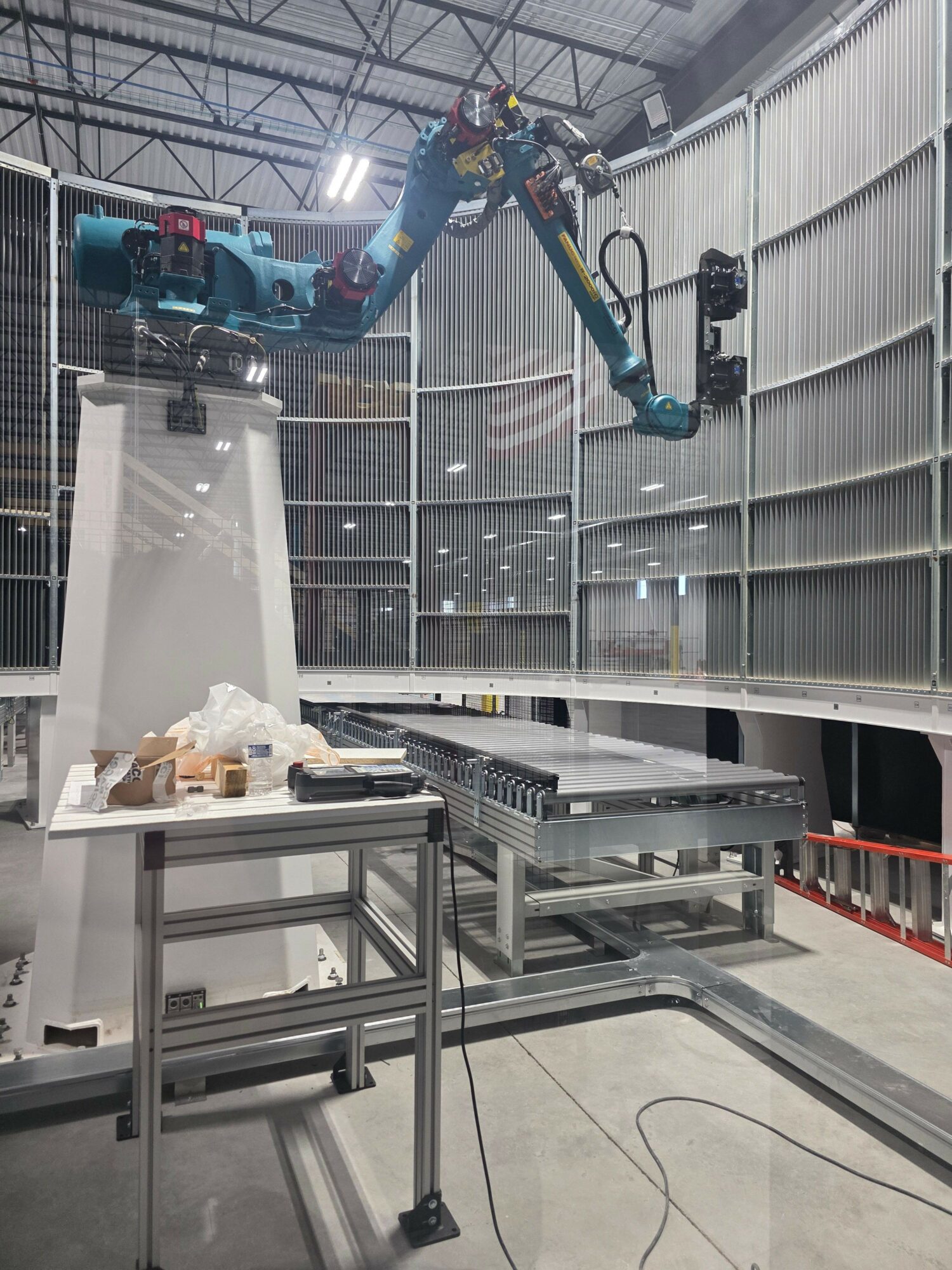
The focus became building around single-part flow and batch-one automation — a system capable of producing custom cabinets in constant flow, minimizing work-in-process. The breakthrough concept was a fully autonomous edgebanding loop — inspired by systems I had seen in Europe — that would anchor the entire production line. From there, we worked with automation partners to build out the front end — panel storage, CNC panel processing, and robotic part unloading and sequencing. The hardest challenge was the back end: bringing all the chaos parts back together in sequence, automated drilling, hardware insertion, hinge placement, and intelligent sorting.
In May of 2023, during another trip to Europe, I saw the missing link — a dynamic library system capable of storing thousands of parts and re-sequencing them via robotic automation. This enabled parts to be cut chaotically at the beginning of the line, brought into this library system, and then released in specific sequence for final assembly, connecting the entire manufacturing flow.
By June of 2023, the vision began turning into reality. We aligned with an integrated automation plan that connected the entire cabinet line — from automated drilling and hardware insertion to the intelligent library system required for true batch-one manufacturing. Getting there took in excess of 80 layout revisions of the factory. There were at least three distinct points where it seemed like it wasn’t going to happen — where we couldn’t deliver on the directive of elevated wages because the layout required too many jobs to hit the throughput. Each time, we went back to the drawing board until the numbers worked.
Throughout this process, we also worked closely with a lending partner to structure financing for a project of this scale. Their guidance shaped key engineering and operational decisions. Every automation choice had to support productivity and long-term wage expansion — if automation was removed and labor added, costs would rise and undermine the core objective.
This project has always been driven by two fundamental goals. First, to help bring modern manufacturing back to America in the casework industry. Second, to expand wages in a meaningful way for the people who work in it. The only way to achieve that is through productivity — automation must handle repetitive tasks so people can focus on reasoning, problem-solving, and continuous improvement.
Alongside designing the automation system, we searched for the right location. Existing facilities did not meet the requirements, so we worked with local communities to identify build-ready sites. St. Joseph had always been home for Hansen & Company, and with the support of local partners and the city, we structured a path forward.
The $25 million project was built primarily through traditional financing — without any federal grants or subsidies — aside from a local Tax Increment Financing partnership with the City of St. Joseph. I don’t believe government should subsidize private companies to the level they do today. Are there times it’s needed? Sure. But if I could make this happen without it — bonus points for my beliefs.
We broke ground in June 2024 with an 18-month build timeline targeting Site Acceptance Testing in early 2026. Despite the complexity and first-of-its-kind nature of the system in North America, the project has remained close to schedule. During this same period, we redeveloped our entire cabinet design platform, launching Cabinet 2.0 within Factory 2.0. We call it 2.0 because that’s what it represents — a new chapter. For me, for HCo, for our team, and for our industry. It’s a second chance to do something amazing and make a difference.
Today, the vision is becoming reality. With ramp-up underway, we expect to reach full production by mid-2026 — bringing to life a vision cast just three years earlier with a mission to redefine what cabinet manufacturing in America can be.
Alright, so let’s dig a little deeper into the story – has it been an easy path overall and if not, what were the challenges you’ve had to overcome?
No, it hasn’t been a smooth road — but I don’t think it’s supposed to be. The pullbacks and rough waters are what build a company that endures.
The 2008 recession hit us hard. Builders we worked with failed to pay, and to stabilize the company I brought in two investors. But that period also forced us to pivot into the hospitality market, which became a defining chapter for Hansen & Company. Without that pressure, we probably never expand into North Dakota, never build out our millwork and surfaces divisions, and never travel to China — which is where the seeds of our automation vision were planted.
COVID brought its own set of challenges. But by that point, we had already been through enough to know the playbook: assess reality, adapt, and move forward.
Every major setback forced a pivot that made the company stronger. I don’t think you get to where we are today — building a first-of-its-kind automated factory — without having been tested along the way. The struggles aren’t something you survive. They’re something you build on.
Thanks – so what else should our readers know about Hansen & Company Woodworks Inc?
We are one-stop partner for commercial interiors. We handle multi-unit casework, architectural millwork and metalwork, and surfaces — granite, quartz, and solid surface. Instead of a developer or GC juggling three or four vendors, they work with one team, one schedule, and one point of accountability. We absorb the coordination stress.
What really sets us apart is how we work with our clients. We listen. We want to understand the designer’s intent, the owner’s vision — how they want a space to feel. We then take that and bring them a product that brings that space to life, differentiates it from other properties, and ultimately makes the end consumer — the person who calls that space home or work — feel that it was put together with real intention.
What allows us to do that is selection. In our volume casework alone, we offer over 800 colors and finishes. Most suppliers give you four or five options. That’s not design flexibility — that’s a limitation. We give designers the palette to actually execute their vision, not compromise it.
And with our HCo 2.0 automated factory, we deliver that level of customization at scale — premium quality, broad selection, without the premium price tag.
Any advice for finding a mentor or networking in general?
Put yourself out there and ask questions. Don’t wait until you feel ready — just go.
I’ve toured roughly 200 facilities over the years, and most of those started with a cold call or a cold email. You’d be surprised how many people will say yes if you just ask. Some of the most impactful conversations I’ve had came from reaching out to companies and people I had no connection to and simply saying, “Can I come see what you’re doing?”
The real advice is this: grind. Immerse yourself in your dream. Too many hours to count, many days 16-plus hours, six and seven days a week for years. But the piece that doesn’t get talked about enough is honing your dream — taking time to put real words and real ideas to your vision. The grind fuels the journey. The clarity is what actually gets you there.
Contact Info:
- Website: https://hcowoodworks.com/
- Instagram: https://www.instagram.com/hcowoodworks/
- Facebook: https://www.facebook.com/HCoWoodworks
- LinkedIn: https://www.linkedin.com/in/adam-hansen-ab371674/