




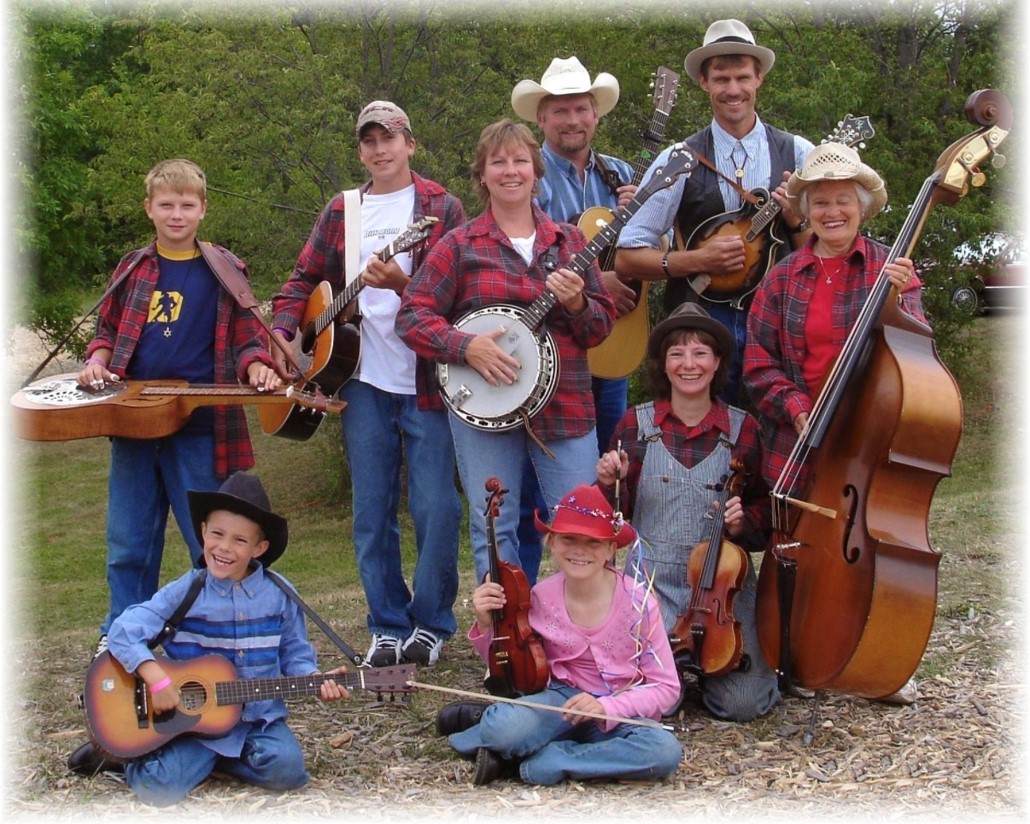
Today we’d like to introduce you to Soren Olesen.
Hi Soren, thanks for joining us today. We’d love for you to start by introducing yourself.
SLOUGHGRASS
How a family in Birchdale started learning together, kept going, and sent two young musicians onto the national bluegrass stage
I never planned to be in a bluegrass band.
Neither did my wife Judith. Neither did Christine or Dave. Grandma Audrey did not wake up one morning and decide to put together a family act. It happened a little at a time.
The story really starts with an old fiddle.
It had first belonged to Judith’s grandfather, Audrey’s dad. He played it in church and in the community orchestra. Audrey inherited the fiddle, and then she gave it to Judith. Judith decided she wanted to learn how to play it.
She found a newspaper advertisement from Dale Blatter, a traveling music teacher from Bemidji. Dale drove around northern Minnesota teaching string instruments. Judith first took lessons from him in in his RV during her lunch breaks in International Falls.
Then Audrey decided she wanted to learn accordion. Dale was already driving through the Birchdale area already, so he began stopping at Audrey’s house. Our nephew Carl Hultman started taking guitar lessons after school at grandma’s house too. Then Judith would stop after work for her fiddle lesson instead of going on her lunch break. Judith’s sister Christine and husband Dave and I began trying different instruments too.
Every other Monday night we would meet at Grandma Audrey’s house. She cooked for everybody so that was a good reason to get together.
Before long, the separate lessons became one big group lesson. Dale would show up, give a few individual lessons and pointers and then we would all sit together in the living room playing and leaning.
We were not very good. That is important to the story.
We were beginners. We were trying to find the G chord, stay together and remember which way the song went. But we kept meeting. We kept playing.
Why Sloughgrass?
The name came from Dave.
We were using bluegrass instruments, but we played the songs very slowly. Dave said it was like trying to walk through the tall sloughgrass behind the house. Slow bluegrass. Sloughgrass.
The name fit us. It had some humor in it. It came from where we lived. It also gave us room to be what we were. We did not have to pretend we were professionals.
Audrey started on accordion but moved to upright bass. Judith played fiddle, guitar and sang. I moved to mandolin. Christine played banjo. Dave and Carl played guitar. Gary Hultman began playing Dobro. Later our daughter Sofia played fiddle and mandolin, and our son Holger began playing Dobro and singing.
At some point we looked around the room and realized we had enough people and enough instruments to call ourselves a band.
Our first public outing may have been in 2001. Dale suggested that we go to the Western Minnesota Steam Threshers Reunion in Rollag and play under an oak tree or something. We went, and somehow the family ended up playing on a stage for about half an hour.
In August 2003 we entered the Family Area talent show at the Minnesota Bluegrass and Old-Time Music Association festival. We won a chance to play one song on the main stage between the regular bands.
That one song mattered.
It made us think that maybe we really were a band. After that we began playing wherever somebody needed music. Nursing homes. Churches. County fairs. Town celebrations. Benefits. Weddings. Reunions. Hockey arenas. If someone called and asked, we usually tried to say yes.
That was how we learned. We did not wait until we were polished. We got better by getting in front of people.
At first, we were afraid of making mistakes. Then we began to notice that most people did not care nearly as much as we did. They wanted to hear a song. They wanted to see a family enjoying itself. If we made a mistake and kept going, the world did not end.
That was a useful lesson for music and for life.
From Birchdale to Denmark
In 2004 we took the band to my hometown of Roskilde, Denmark.
We like to say that Sloughgrass toured Europe. That sounds better than saying we played near the train station in the rain.
We played on a square in front of the Roskilde train station at about four in the afternoon. The weather was poor and the crowd was not large. But we played. The family from Birchdale stood in the town where I had grown up and played American bluegrass, country and Scandinavian music.
It was not a glamorous international tour. It was still important.
That became part of the Sloughgrass way. We could laugh at ourselves and still take the opportunity seriously.
In 2005 we recorded our first CD, Down the Road, at Bemidji Music Center.
We did not know how long that exact version of the family would stay together. Children grow up. People move. Older people do not stay with us forever. We wanted to save what we sounded like at that moment.
We started with 100 copies. We sold more than we expected, and people began asking when we would make another one.
In 2007 we recorded Are We There Yet? in our church in Birchdale. We recorded on a Friday night after the children were out of school and then continued on Saturday. The title came from what the kids kept asking when we traveled.
In 2011 we recorded Not Quite There at Kezar Music in Thief River Falls.
Those three titles tell part of the story: Down the Road. Are We There Yet? Not Quite There.
We were always going somewhere, but we never claimed we had arrived.
In 2009 we bought an old 1987 Ford airport shuttle bus from the Salvation Army in International Falls.
It had been sitting there with a for-sale sign in the window for a while. We turned it into a rough family RV and drove south to see where the music we played came from.
In twelve days we traveled about 3,500 miles through eleven states.
We stopped at Bill Monroe’s childhood home at Jerusalem Ridge in Kentucky.. After the tour, we were invited to play on the porch. We visited Nashville, went to the Grand Ole Opry, saw Bill Anderson and Little Jimmy Dickens, and heard the Time Jumpers at the Station Inn.
In Coeburn, Virginia, we found a Thursday-night jam in an old hardware store. We played for hours with people who had grown up around this music.
Then we found Brown’s Ole Opry outside McLeansville, North Carolina. It was an old tobacco barn down a small road. We arrived too early for the event we thought was happening, but the owner let us hang out, soon other musicians and listeners began showing up. Before long people were flat-foot dancing on the wooden floor and bands were taking turns onstage.
We had gone south looking for the “real” music. What we found was not a museum. It was people sharing songs, making room for strangers and keeping a community tradition alive.
That felt familiar.
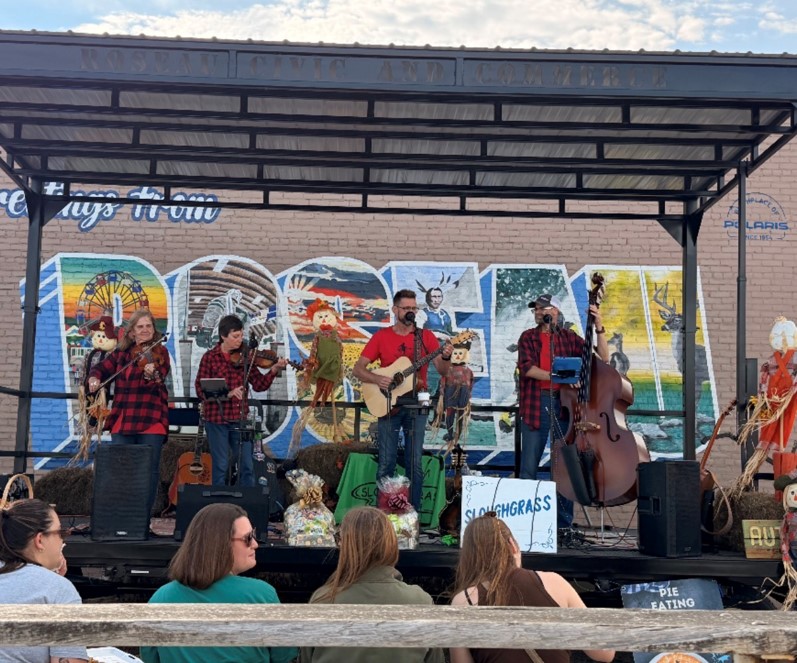
Later that summer we played six shows during the opening weekend of the Minnesota State Fair. We also played live on Joe Soucheray’s Garage Logic radio show.
That was a long way from trying to find the G chord at Audrey’s house.
One of the best things Sloughgrass has done is the Absolute Beginner workshop at the MBOTMA August festival.
We started it around 2004. We brought guitars, fiddles, banjos, mandolins, basses and Dobros. People could choose an instrument and learn enough to take part in one song.
We usually teach “Shortening Bread.”
The point was not to make someone good in one hour. The point was to let them begin. Someone once called our workshop “A gateway drug to Bluegrass”.
Some people could just hold one chord and try to keep time. That’s fine. Others would learn the melody. The faster learners help the slower learners. Then we make a large circle and play together.
That workshop came directly from our own experience. Nobody made us pass a test before Dale let us join the music. We learned by being included.
We later used the same idea with students and senior citizens. Participation came first. Skill could grow after that.
In 2011 Sloughgrass was featured in a KSRQ radio program through the Ampers public radio network.
In 2012 we recorded an episode of Prairie Musicians at Prairie Public Television in Fargo. That program captured the full family band: Audrey, her daughters, sons-in-law and grandchildren.
When I watch it now, I see more than a television show. I see a particular time in our family. Audrey is still there on bass. The kids are becoming serious players. We are all close enough to gather around the same microphones.
In 2013, ten years after our one-song talent-show performance, Sloughgrass played a full main-stage set at the MBOTMA August festival.
We had not become famous. We had simply kept going.
The young people took it farther
The younger musicians also formed their own band, Ditchgrade, with Maria Lewis. They recorded a demo in 2011.
That was another step. They were no longer only the children in Sloughgrass. They were choosing songs, working out arrangements and building their own sound.
Two of those young musicians, Gary Hultman and Holger Olesen, eventually made bluegrass their profession. Holger played for several years with other teenagers in the Minnesota band Porcupine Creek.
Gary grew up playing in the family band but became very serious about the Dobro. He went to Rob Ickes Reso-Summit for years and then on to East Tennessee State University to study Bluegrass, Old-Time and Country Music.
At ETSU he played in the Bluegrass Pride Band and had opportunities we could hardly have imagined when he was learning in Birchdale. In March 2015 he performed at an ETSU showcase with Ricky Skaggs and in 2016 he sang with Doyle Lawson at the same Showcase. He toured Japan with the Bluegrass Pride band. Then he went on to play with The Boxcars and the Highland Travelers. In 2019 he joined Blue Highway. What professional players, like Ron Stewart, have told me about Gary’s playing is that he listens. He does not play just to show what he can do. He plays what the song needs. That’s a special talent.
Holger watched Gary closely. Gary showed him that a boy from Birchdale could become a serious Dobro player.
Holger also attended Rob Ickes’ ResoSummit and received the Houston Caldwell scholarship in 2013. He later studied both Engineering Technology and Bluegrass music at ETSU. Today he teaches guitar building and Engineering courses at ETSU and he has toured with The Little Roy and Lizzy Show full time since 2020. He plays bass, sings and still plays Dobro. In 2024 he won the Dobro contest at the Old Fiddlers’ Convention in Galax, Virginia. In 2026 he was nominated for SPBGMA Dobro Performer of the Year. In June 2026 he got a chance to sit in on bass with Rhonda Vincent and the Rage at the Grand Ole Opry for the second time.
Every family band changes.
The children grew up and moved on. Gary and Holger built lives in Virginia and Tennessee. Sofia followed her own path out west to Wyoming and Carl went to Alaska. Grandma Audrey passed away. Dave no longer plays regularly with the band.
For a while it was difficult to know what Sloughgrass was without the full family lined up across the stage.
But the music did not stop. The band has seen different configurations but kept going.
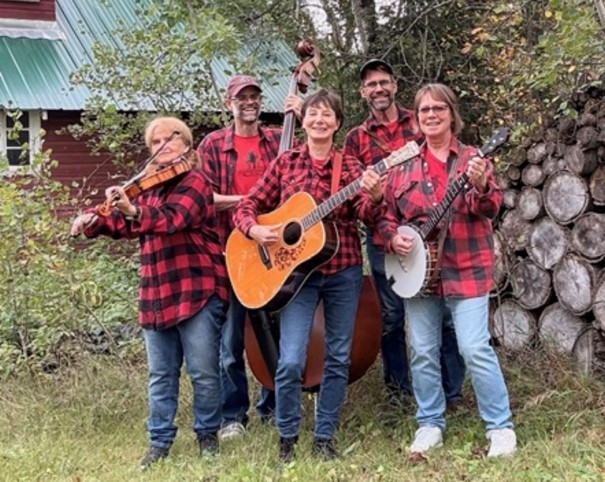
The current band is Judith Nelson on guitar, fiddle and vocals; Christine Hultman on banjo and vocals; Joe Olson on upright bass and guitar and vocals; Julie Olson on viola; and me on guitar, mandolin, bass and vocals.
We still play fairs, nursing homes, community events, resorts, churches and festivals. We still wear red plaid more often than necessary.
The biggest change in the band probably is Judith’s songwriting.
She has written songs for years, but gradually the original songs became a larger part of our shows. Now they make up about half of what we play.
That changed the sound of Sloughgrass.
We still play bluegrass, country, gospel and older songs we like. But Judith’s songs come from life experiences. Judith writes songs that reflect the stories in her life, in this place and time. Some songs are meaningful and make you ponder, like This River Runs Wild, others like Old Green Ford and Minnesota Hotdish are humorous and crowd favorites.
In early 2026 the current band recorded seven of her songs at Reverb & Echo Studio in Hugo: The Story of Your Life, The Journey, This River Runs Wild, Koochiching Clay, Seafood and Tears, Musings From a Car and Bowl Full of Sorrow and releassed then to online platforms.
The Story of Your Life was written for Sofia. The Journey was written for Holger when he was away at college. This River Runs Wild comes from living beside the Rainy River. Koochiching Clay is about the ground and the people who keep working it, all of Judith’s songs tells a story.
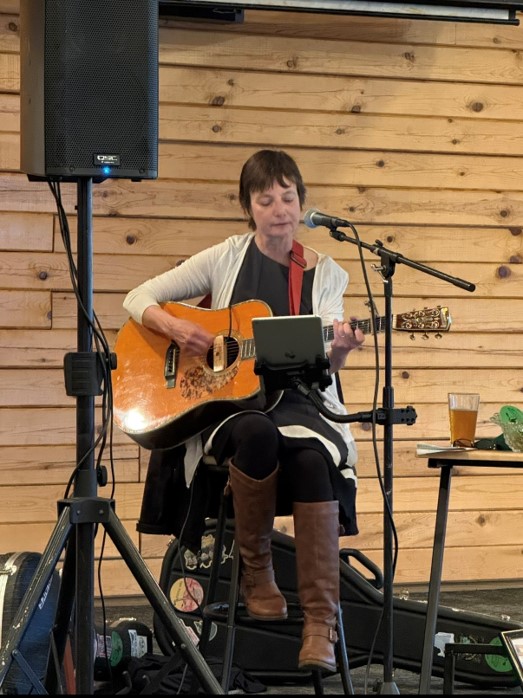
Judith also sometimes performs the songs by herself. That matters because a song sounds different when the writer sits alone with a guitar and sings it. There is nowhere to hide. The words have to stand on their own.
The new recordings are not an attempt to sound like somebody from Nashville or Appalachia.
They sound like Judith. They sound like us, Sloughgrass. They come from where we live.
What the band really gave us
It is easy to tell the Sloughgrass story by listing the big things.
We played in Denmark. We played at the Minnesota State Fair. We appeared on radio and television. Gary joined Blue Highway and is on the radio all the time. Holger tours full time accross the country and played the Grand Ole Opry.
Those things are worth celebrating.
But they are not the whole story.
The real story is that a family began learning together and did not wait until everything was perfect.
Audrey cooked for everyone on Monday nights. The kids grew up around instruments and microphones. We played for people in nursing homes who may not have remembered our names but knew the songs. We taught beginners who were afraid to touch an instrument, and we all learned a little together and became better. We learned that making a mistake in public was survivable.
Two young musicians carried that start onto national stages. The rest of us kept playing back home.
That feels about right.
The fiddle Audrey gave Judith had already passed from one generation to another before Sloughgrass began. The music did the same thing.
It moved through the family. Then it moved out into the world.
And it still comes back to Birchdale.
Appreciate you sharing that. What else should we know about what you do?
Our family band hands on absolute beginner workshop. It has been a great way to meet other people and some of they went on to become musicians and make their own bands. We never has forgotten what it means to be a complete beginner that now noting about instruments.
Where we are in life is often partly because of others. Who/what else deserves credit for how your story turned out?
All of our music friends that we have camped with and played music with over the years. Other family bands and people that mentored our kids.
Contact Info:
- Website: http://www.sloughgrass.com
- Instagram: https://www.instagram.com/sloughgrass/
- Facebook: https://www.facebook.com/profile.php?id=61554437446160