





Today we’d like to introduce you to Judy Anderson.
Alright, thank you for sharing your story and insight with our readers. To kick things off, can you tell us how you got started?
I got turned on to ceramics as a teenager. I was fortunate to attend a high school that had a strong and diverse art department, and clay was among the classes that held my focus. I attended the University of Minnesota and studied Studio Arts, emphasizing Ceramics. I was blessed to study under the iconic Warren MacKenzie. Back then, I didn’t know he was a big deal. He was just a quietly funny and humble professor.
After college, I took 14 years off from clay and raised a family. I joined a Community Studio on the recommendation of a psychic (no, really!) After a year or so, I began to sell my work, underdeveloped as it was. I continued to try new decoration methods as I honed my throwing abilities. Soon, I was asked to teach at the studio. I enjoyed teaching partly because it forced me to analyze my work: why I did things the way I did. It helped me look for alternative ways of working and focus on my students’ different learning styles. I left the group studio and started to work from home. I acquired a used wheel and kiln and fired my work using the firing knowledge I had gained working as staff at the group studio.
Developed by the current body of work from a vision: I had an image in my head that would not fade. Every time I blinked my eyes, I saw the image. It was a Smiling Pig! For close to a week, the Smiling Pig preoccupied my thoughts. When I applied colored slip to a pot and carved his image onto it using the Sgraffito method, the image went away from my brain, but I was left with a new decoration direction.
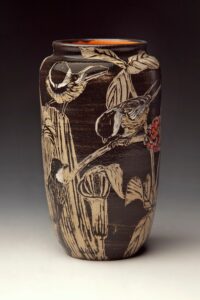
The Sgraffito opened a whole new world of inspiration for me. I utilize images of wildflowers, insects, animals, and birds. The work seems to resonate with many people, and it is fun to see which image someone will connect with. I feel blessed to be able to have my art in someone’s home, that they might use it every day and that it adds beauty to people’s lives. I show my work at the gallery my husband and I have in Wabasha, Minnesota.
We all face challenges, but looking back, would you describe it as a relatively smooth road?
I am fortunate to make my pottery in an area of the country where ceramics is ‘hot.’ However, not all of my decoration methods have been very successful. I immersed myself completely as I learned new techniques, such as underglaze painting, carving, wax resist designs, dipping, and spraying glazes. Some of the work sold, but a lot of it didn’t. It wasn’t until I began making Sgraffito that my sales soared.
Can you tell our readers more about what you do and what you think sets you apart from others?
My current body of work relies heavily on the Sgraffito method of decoration. Sgraffito is accomplished by scratching away part of the surface. A piece is wheel-thrown, then set aside to firm up. When it reaches a stage of dryness where I can handle it without distorting it, the ‘leather-hard’ stage, then I apply, with a brush, a contrasting liquid clay called ‘slip.’ I typically use black slip for the best contrast to my buff-colored clay. When the slip has dried to the ‘just right’ stage, meaning that it is dry enough to make a pencil mark on top without the pencil scratching into the slip, I begin my drawing. I work from photographs. I seek photos of my subjects showing movement or an intriguing position. I do strive for the utmost accuracy in my images. I hand-draw every one of my designs; I do not use stencils. Once the drawing is complete, I use tiny metal loop tools to remove certain parts of the slip. This allows the image to emerge. When I have finished carving, I often use a colored underglaze to add pops of color. Then the work dries and is bisque fired to 1875°F. After the bisque firing, I use a bright glaze to cover the insides, typically taking my color cues from the images. Then I apply a clear glaze to the outsides and fire again, in my electric kiln, to a temperature of about 2232°; the results often resemble that of a woodblock print.
Have you learned any interesting or important lessons due to the Covid-19 Crisis?
I feel so lucky to be in the line of work that I am! During the Covid-19 shutdown, I kept my head down and kept right on making. I offered some online sales with contact-free delivery or pick-up, but ceramics don’t expire, so I sold all the work I made later.
I did some tribute pieces concerning Covid-19: at the start of the pandemic, there was talk of the species from which the virus crossed from the animal kingdom to humans. Pangolin got much of the blame, and I felt bad for the poor creatures. I made a series of Pangolin pots- vases, tumblers, and bowls-to show my sympathy for this creature receiving such bad press.
Contact Info:
- Website: www.dragonflyguildpottery.com www.localworldgallery.com
- Instagram: @dragonflyguildpottery
- Facebook: Dragonfly Guild Pottery


Image Credits
All pottery images by Ryan Ball Photography