




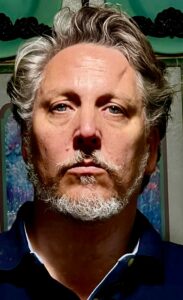
 Today we’d like to introduce you to Kyle Fokken.
Kyle, we appreciate you taking the time to share your story with us today. Where does your story begin?
In my practice as an artist, I consider what I do as 3-D collage sculpture. I have always been an artist being interested in drawing, constructing – making things from a very young age. I grew up in a small farming community with very little money so my mother taught me how to draw and paint and always made sure that there were interesting projects to work on. As I grew older, I was very interested in making model cars and airplanes. Since I could seldom afford to purchase new kits to complete, I would ‘source’ discarded plastic models from the trash that were thrown away by my friends and rework them. I would transform the models into dioramas showing the wear, battle scars or crash damage based on books I found in the library. In doing so, I learned how to complement the models with found objects that look like they could be components of the real thing. This process of seeing beyond the initial use of an object helped me to think like an engineer and to look at all things with an eye towards its design and function.
I refer to this process as my ‘make do aesthetic’. This thought process is in league with people all over the world ‘making do’ with what they have by repurposing material to fit their needs. It is in the nature of survival and the heart of folk art and cultural traditions that are also expressed through cooking, dance, fashion and belief.
Would you say it’s been a smooth road, and if not what are some of the biggest challenges you’ve faced along the way?
It has never been a smooth road to be an artist and I consider myself largely self-taught in almost everything I do.
I was the first person to go to college in my direct family line and I’m proud of that fact. In my hometown, very few people completed an education past a vocational school, the military or work. I started off in a vocational school to study electronics but a friend noticed me spending a lot of my time drawing in class so suggested I give the adjacent community college a try. I took a few art classes and loved them so transferred to St. Cloud State University to study painting. I soon fell into a ceramics class and graduated with honors and a business major, having never taken a painting class.
While in college I did some volunteer arts administration for the University and thought that that might be another avenue to explore since prospects of paying my way as an artist were slim and I couldn’t see myself setting up pottery anytime soon. After a clay apprenticeship under a potter and an internship at the Minnesota Museum of American Art, I wound up in Toronto Canada, working as a fundraising manager for classical music, ballet companies and museums. When that didn’t work out, I found my back to Minneapolis to work my way up a succession of jobs culminating in Mortgage Sales in the mortgage banking industry. I was successful which allowed me to do some world traveling but I wasn’t happy so after getting married my wife recommended that I just have a go at making art with the deal being that I also raise our two kids.
Since then, I’ve sold a lot of work, won a number of artist grants and awards and had shows in many places in the midwest, NYC, Canada and China. I’ve recently been making public art which has been both rewarding and challenging.
As you know, we’re big fans of you and your work. For our readers who might not be as familiar what can you tell them about what you do?
I am mostly known for my well-crafted “mashups” as one journalist from Minnesota Public Radio labeled my works.
I tend to make sculptures that are a blend of oddly diverse imagery cobbled together. I am known for my ‘wooden shoe’ tanks, my church airplane, my cello/violin sailing ships and my flying dogs. All of these elements are personal totems that I use in varying ways to come up with new concepts – i.e., the sum is greater than its parts.
I generally start out with an image in my head and then work backwards to see what sort of relevance the image has on me or current events. I use a lot of found objects and mixed media but I do so with the intent of finding the right object to fit the piece rather than having the found object dictate the narrative of the work.
I strive for meaning in my work but in the process allow for loose translations and other interpretations. This gives the work ‘life’ and keeps the interest of the viewer and maybe offers some insight into the intent of the artist.
Like every artist, I’ve had my share of hits and misses. I think anytime that I’m stretching myself artistically, I do work that challenges and surprises me. I love almost all of my mixed media ‘toy’ type sculptures since I don’t see anything quite like them and I delight in the material choices and how well the forms hold up over time.
I’m happy that a number of them have found homes in public collections and museums. The public artworks are made under contract with many of the ‘sharp edges’ metaphorically and physically worn down. This is the nature of public art that has to blend in with the communities that they are chosen for.
One of my favorite public pieces was the pair of raging bulls that I made for a couple of private superfan sports boosters of the Mankato Mavericks Hockey Team. The piece “The Guardians – The Wary and the Fierce” were their conception and I was happy to realize their vision for steaming bulls with glowing eyes. The pieces are so organic and flowing and so alive and I love how the fans have embraced them.
So, before we go, how can our readers or others connect or collaborate with you? How can they support you?
Working with clients and public administrators is a form of collaboration. Everyone has slightly different goals but works together to make the entirety of the public space coalesce. As part of this process, I have meetings with community stakeholders who share their opinions, concerns and ideas with me which is also a form of collaboration. I prefer to maintain the artistic direction of the work but I often have to amend it slightly to accommodate tastes, scale, materials and other concerns.
The best way to support an artist is to buy their work. That way the artist can just be free to create and everyone is happy.
Other forms of support have been in the sharing of skills. I have taken small welding or repair jobs for galleries and other artists which are a nice diversion and I am happy to help. Artists can also be supported by the committees that choose artwork to be knowledgeable about the work the artist produces and why they make it. It would be wonderful more citizens cared about getting the most unique works of art to truly differentiate their communities rather than going the more ‘safe’ route of native landscapes and animals.
Finally, we live in a world of images and connections so anytime you can support an artist that you like please ‘like’ and ‘share’ their information with friends, family, colleagues, and associates. The more that we can educate the wider public with our work and its value of it the better it will be more widely accepted.
Contact Info:
- Website: www.KyleFokken.com
- Instagram: kfokkenart
- Facebook: Kyle Fokken – Artist


Image Credits
“The Song of the Flying Dutchman (Ship Series)” and “Airway to Heaven (Church Series)” shot by Sarah Whiting Photographic