





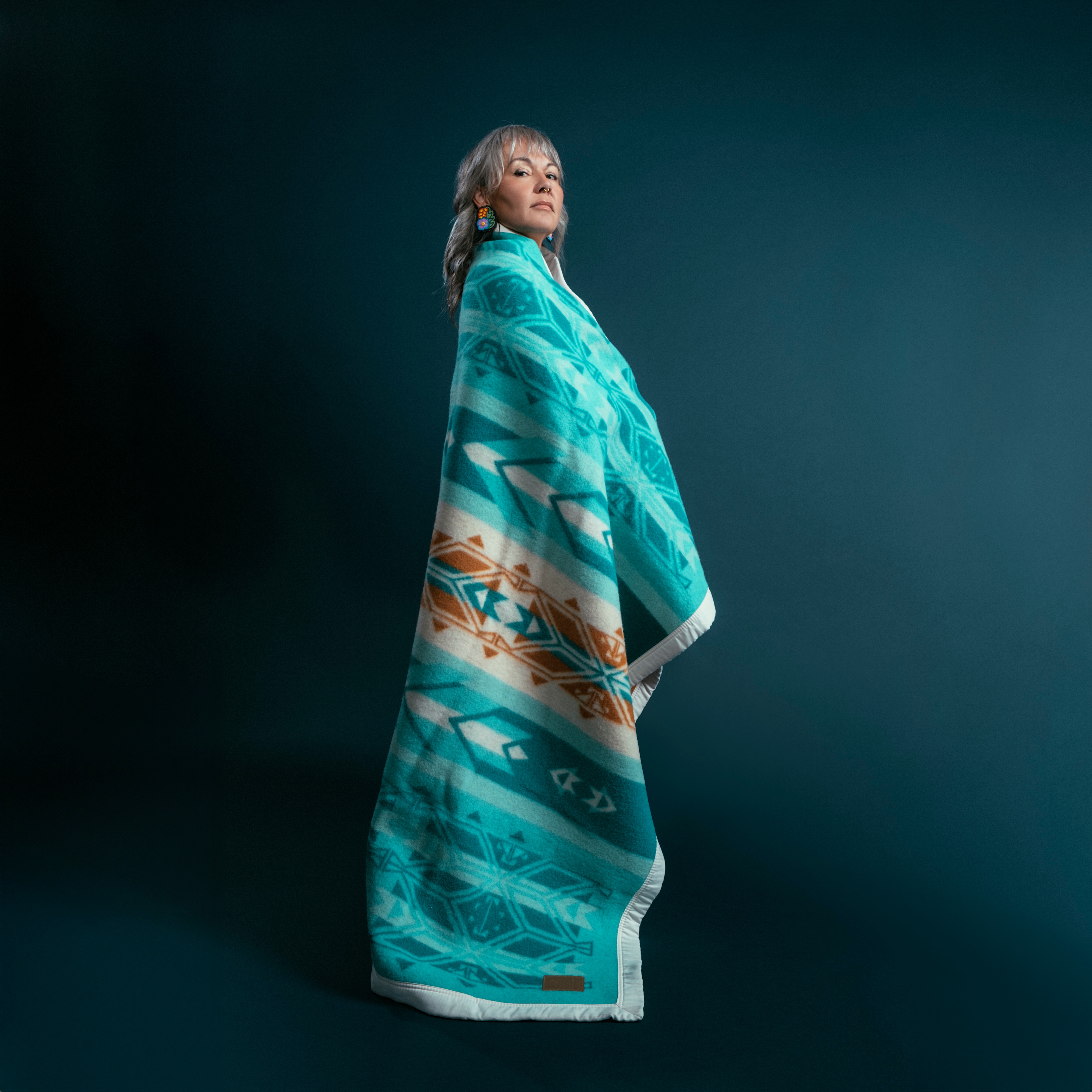
Today we’d like to introduce you to Giizh Agaton Howes.
Hi Giizh, can you start by introducing yourself? We’d love to learn more about how you got to where you are today?
Heart Berry began as House of Howes in my kitchen in Northern Minnesota on the Rez.
In 2014, House of Howes was a small custom regalia business.
I created custom beadwork,
quilts, regalia, and moccasins for clients across the midwest.
The demand for cultural art and cultural tools quickly out grew
what I could manage. That is when I started teaching community HOW to be
makers.
Meanwhile– In Seattle Washington, Nooksack artist and teacher
Louie Gong began to follow his vision to create a Native Lifestyle
Brand Eighth Generation.
Alongside Gong’s new brand, he wanted to mentor and provide
space for Native Arts Entrepreneur. Through creating an alternative
to brands culturally appropriating Native designs his work was
changing the narrative around Native Entrepreneurship. Our focus was to take back the wool blanket.
Gong contacted me in 2014 to become a part of the Inspired Native™ Project.
I literally clicked my heels. Imagine the
person you admire the most sending you a message asking if you’d like to work with them!
Gong’s mentorship continues to change the lives of Native entrepreneurs across the hemisphere
and his vision to build Eighth Generation
has built it into the largest Native Brand in North America.
Rooted in her beadwork designs,my art is embedded in the Ojibwe Floral tradition.
Bringing to life and the market the foods, medicines, and stories of my community,
I love to bring the traditional and contemporary together.
From pencil to the computer to the studio.
From the Rez to Heartberry.com.
Heart Berry is the confluence of many moments.
Grown from this experience what was “House of Howes” became “Heart Berry” in 2019.
The Ode’imin or “heart berry” has been a constant in my work whether in art, canoeing, or community.
At our heart is always our community work. From art residencies to moccasin classes to canoe migrations. Cultural connection and learning as a lifelong practice is a focus of our cultural revitalization.
We collaborate with tribes, organizations, and architecture firms. From installations to painted murals, you now see Heart Berry now on walls, windows, and waterparks. The institutionalization of our stories and perspective is vital to changing the narrative around whose stories and values matter.
We give back. Along our entire path we have given back to small non profits. From our Protect ICWA initiative donating over $8000 to the ICWA Law Project to our Native Scholarship Fund, we are always organizing ways to GIVE BACK to our community. This reciprocity is a cultural practice but also a way to live in line with our values.
Can you talk to us a bit about the challenges and lessons you’ve learned along the way. Looking back would you say it’s been easy or smooth in retrospect?
This is such a fun question. I like to tell people that the role of the artist and entrepreneur is truly a problem solver, box hauler, and rider of the doubt train. One day you’re sorting why a widget doesn’t work on an email and the next working on your 35 art boards to create something you can believe in.
Every day is a moment to learn and grow. It never stops. From my start learning how to build a website or how to be a boss to others and the many mistakes I have made on the way I am in a growth pattern at all times.
But when I was a kid my mom told me “Find something you love to do and someone willing to pay you to do it.” This has informed my whole approach to life. What kind of life are we trying to make? What do we want to model and give to the next generation? What kind of ancestor am I trying to be?
The constant push within American capitalism to grow grow grow can be challenging to navigate as an Anishinaabe artist and entrepreneur because I need to constantly put myself back onto my path and stay true to my heart. This often takes me down paths that are unconventional and not focused on profit but on community, on revitalization, and giving back. This is why I pay my staff a good wage and provide PTO. Why we donate time and money to organizations who do good work. Why we make ourselves available to teach. I often feel like I am trying to hack my way through a dense forest that is beautiful and lush but I am unsure the path ahead.
This is why I named Heart Berry after the “ode’imin” to remind myself and others to follow and listen to the heart above all else. At the end of my life I want to look back and know I created a path but that I also shared it with others.
Alright, so let’s switch gears a bit and talk business. What should we know about your work?
Heart Berry is known for creating design from our Ojibwe floral tradition. These foods, medicines, and plants were etched, quilled, and beaded onto our functional objects since time immemorial. They were beaded onto bandolier bags during the time when our ways of life were outlawed so that we would never forget. The gifts of the world and water around us are abundant and our ancestors knew how to thrive in and with that world. These designs remind us of that goodness. I work to merge those worlds with today.
How do you think about luck?
I guess I don’t believe in luck. I’ve lived through deep earth shattering grief and loss as well as achieved my wildest dreams. Neither of these feel lucky or unlucky. For me as a person who has taken my grief and tried to make sense and purpose of it, luck doesn’t “work”.
I believe we can take any experience and make what we can of it. I don’t believe things happen for a reason or in any kind of karma because it’s too painful for me to imagine that some of these hardships are deserved.
I believe our ancestors thought about us and kept as much of themselves safe as they could for us to be here. I believe I am surrounded by their presence and gifts. I believe I am fortunate to have had many mentors and teachers who shared their knowledge and experience with me. But these are as much responsibility and an Anishinaabe value as anything. I do feel truly fortunate to have this good life and grateful for it.
Contact Info:
- Website: https://heartberry.com
- Instagram: heartberryco
- Facebook: Heart Berry