





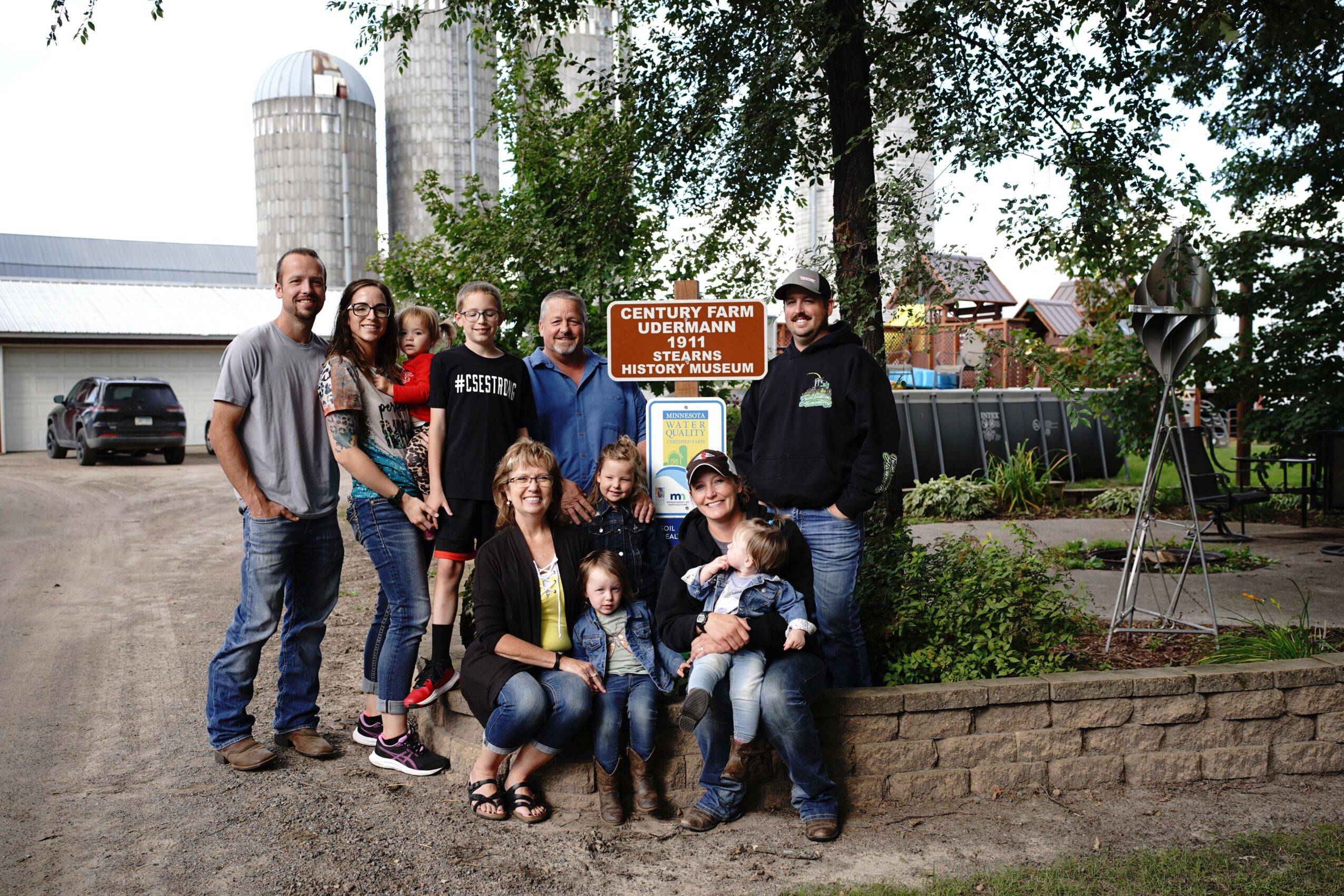
Today we’d like to introduce you to Alex Udermann.
Hi Alex, it’s an honor to have you on the platform. Thanks for taking the time to share your story with us – to start maybe you can share some of your backstory with our readers?
Meadowbrook Farm direct sales started from a willingness to question the conventional path and rebuild our operation around long-term resilience — economically, environmentally, improve soil and human health, and for the future of agriculture as a whole.
Like many family farms, we originally operated within a more traditional system that relied heavily on purchased inputs, tillage, and the constant cycle of trying to produce more while margins continued to tighten. Over time, we began noticing the warning signs many farmers see but often feel powerless to change: soils becoming harder and less resilient, water infiltration issues, rising fertilizer and chemical costs, increasing equipment expenses, and a system that demanded more every year while giving less back. We realized that if agriculture was going to remain viable for the next generation, we needed to rethink the foundation of how we farmed.
That realization started a long process of learning, experimenting, and rebuilding our system from the ground up. We began implementing no-till practices and studying soil biology more closely, focusing on keeping living roots in the ground as much of the year as possible. We incorporated diverse cover crop systems to improve soil structure, nutrient cycling, water retention, and microbial activity. Instead of viewing soil as simply something to hold a crop upright, we began managing it as a living ecosystem.
As our understanding grew, so did the scale of what we were doing. We started developing alternative forage systems not only to improve soil health, but also to create higher quality feed sources for our cattle. We worked extensively with multi-species cover crop blends and forage crops to feed youngstock and steers, allowing us to reduce and in some areas completely remove alfalfa from portions of the ration. That became a major turning point because it showed us that regenerative practices were not just environmentally beneficial — they could solve real economic and management challenges at scale.
One of the biggest misconceptions about regenerative agriculture is that it only works on small hobby farms or grazing operations. Our farm has become proof that regenerative principles can work in a large-scale production system without grazing livestock. We have focused heavily on integrating crop production, soil health, nutrient efficiency, and livestock feeding systems in a way that remains practical, scalable, and economically sustainable for working farms.
Over the years, we have continued refining systems that reduce dependency on outside inputs while improving resilience from the ground up. Healthier soils have improved water infiltration and moisture retention during extreme weather swings. Increased biological activity has helped nutrient availability. Diverse rotations and cover crop systems have improved forage quality and reduced pressure on purchased feed and fertilizer inputs. Rather than chasing maximum short-term yields at the expense of everything else, we’ve focused on building a system that performs consistently, lowers risk, and improves over time.
At the same time, we began direct marketing our beef because we wanted consumers to better understand how their food is raised and reconnect with the value behind farming done responsibly. Meadow Brook Farm Direct became more than just selling beef — it became a way to build transparency, trust, and education between agriculture and the communities we serve.
As our operation evolved, we started gaining attention from other farmers, organizations, and researchers interested in practical regenerative systems that could work in the real world. That has led to opportunities for mentorships, farm tours, interviews, speaking engagements, and collaborations focused on soil health, regenerative agriculture, forage innovation, and economic sustainability. What makes our story unique is that we are not speaking from theory alone — we are actively operating and refining these systems every day on a working farm that has to remain profitable and productive.
Today, Meadowbrook Farm stands at the intersection of regenerative agriculture, practical innovation, and production farming. Our mission is not simply to grow food, but to help demonstrate that agriculture can heal land, strengthen rural communities, improve food quality, and remain economically viable all at the same time. We believe the future of farming will belong to operations that learn to work with biological systems rather than against them, and we’re proud to be part of helping lead that transition.
Alright, so let’s dig a little deeper into the story – has it been an easy path overall and if not, what were the challenges you’ve had to overcome?
It definitely has not been a smooth road, and in many ways the challenges are what shaped the farm into what it is today.
One of the biggest struggles was making changes in an industry where stepping outside the conventional system can be risky both financially and socially. When we first started moving toward regenerative practices like no-till, diverse cover crops, and alternative forage systems, there was not a clear roadmap for how to do it successfully at scale in our area. A lot of the information available was either highly academic or based on very small operations that did not face the same realities we did as a working production farm. Much of what we’ve built came through years of trial and error.
There were years where experiments did not go as planned. Cover crops sometimes failed due to weather. Learning how to manage high-residue systems without tillage came with a steep learning curve. Developing forage systems that could consistently replace portions of traditional feed rations required a lot of testing, observation, and adaptation. We had to learn how biology, timing, equipment, weather, livestock nutrition, and economics all interacted together rather than viewing them as separate pieces.
Financially, transition periods can also be difficult because many regenerative practices require upfront investment, patience, and long-term thinking before the full benefits show up. At times, it felt like we were carrying the cost and risk of innovation ourselves. There were moments where it would have been easier to go back to the way things had always been done.
Another challenge has been overcoming skepticism. Agriculture can understandably be cautious about change, especially when farms are already operating under tight margins and high pressure. Some people viewed regenerative agriculture as unrealistic, unscalable, or purely ideological. Because of that, we felt a responsibility to prove that these systems could work practically and economically on a real farm — not just in theory. That meant focusing heavily on measurable results, efficiency, and building systems that could stand up to real-world conditions.
Weather has also continued to be one of the greatest challenges. Farming has always involved uncertainty, but the increasing swings between excessive rainfall, drought conditions, and unpredictable seasons have made resilience more important than ever. Those experiences reinforced why soil health matters so much. Some of the practices we adopted out of necessity years ago have become critical tools for handling weather extremes today.
Balancing growth, innovation, and family life has also been part of the journey. Farming is demanding physically, mentally, and emotionally, especially when you are trying to build something different while still keeping the operation financially stable. There were many long days, setbacks, and difficult decisions behind the scenes that people never see.
At the same time, those struggles also created some of our biggest breakthroughs. Every challenge forced us to think differently, adapt, and improve the system. Looking back, the difficult years taught us more than the easy ones ever could. They gave us a deeper understanding of how resilient farming systems are built and strengthened our belief that agriculture can be productive, profitable, and regenerative at the same time.
Thanks – so what else should our readers know about your work and what you’re currently focused on?
At Meadowbrook farm, we specialize in regenerative agriculture systems that are built to work in the real world at production scale. Our operation focuses on soil health, no-till farming, diverse cover crop systems, alternative forage development, and regeneratively raised beef production. Everything we do is centered around building healthier soils, reducing dependency on outside inputs, improving long-term farm resilience, and producing high-quality food in a way that strengthens the land rather than depleting it.
One of the areas we are most known for is developing practical regenerative systems that can function at scale. A lot of regenerative conversations tend to focus exclusively on pasture-based systems, but our operation has worked to show that regenerative principles can also be successfully integrated into large-scale crop and livestock operations through biology-driven management, cover crop integration, nutrient efficiency, and innovative forage systems.
We have spent years experimenting with diverse cover crop blends and alternative feed systems for youngstock and steers, allowing us to reduce and in some cases eliminate alfalfa from portions of the ration while improving soil function and overall system efficiency. We focus heavily on keeping living roots in the soil, maximizing biological diversity, improving water infiltration, reducing erosion, and building long-term resilience against weather extremes and rising input costs.
What sets us apart is that our work is deeply rooted in both innovation and practicality. We are not operating from theory, research plots, or trends — we are actively farming every day and making these systems work under real economic pressures. Every practice we adopt has to make sense agronomically, operationally, and financially. That practical mindset has helped us build systems that are productive, scalable, and replicable for other working farms.
A major part of our mission is recognizing the connection between soil health, animal health, and human health. We believe healthier soils produce healthier plants, which support healthier livestock and ultimately healthier food for the people consuming it. Through our direct beef sales, we’ve had many customers share positive experiences after switching to our beef — from improved digestion and reduced inflammation to simply feeling better about the quality and sourcing of the food they feed their families. While every individual experience is different, hearing those stories reinforces our belief that the way food is raised matters.
We are equally proud of the improvements we’ve seen on the land itself. Over time, we’ve watched degraded soils regain structure and biological life. Water infiltration has improved, erosion has been reduced, and fields have become more resilient during both heavy rains and dry periods. Instead of fighting nature, we’ve focused on creating systems that work alongside natural biological processes, and the long-term improvements in soil function have been one of the clearest signs that we are moving in the right direction.
Beyond farming itself, we’ve become passionate about education and transparency. Through direct marketing, farm tours, mentorships, interviews, and speaking opportunities, we try to bridge the gap between consumers and agriculture while also helping other farmers explore practical regenerative solutions. We believe agriculture moves forward best when farmers share knowledge openly and learn from one another.
What we are most proud of is building a system that proves regeneration and profitability do not have to be opposites. We’ve been able to improve soil health, reduce reliance on purchased inputs, adapt to changing environmental conditions, produce nutrient-dense food, and continue operating as a productive farm business at the same time. We are proud that our farm stands as proof that large-scale agriculture can evolve in a way that benefits farmers, consumers, rural communities, human health, and the environment together.
More than anything, we are proud of the fact that we are building something sustainable for the next generation — not just financially, but biologically and environmentally as well. Our goal has never been to follow a trend. It has been to create a resilient farming system that can continue improving long after we are gone.
What do you like best about our city? What do you like least?
Sartell is a great place to raise a family, and that stability is something we really value. It’s a safe, well-organized community with strong schools, good parks, and easy access to the St. Cloud area without feeling overly busy or congested. It’s the kind of place where day-to-day life is steady and predictable, which works well for both family life and running a business.
One of the things that also stands out is the natural landscape in and around the area. We have a mix of lakes, streams, wetlands, and direct access to the Mississippi River corridor, which adds a lot of ecological diversity and natural beauty to the region. That water presence plays a big role in the local environment and gives the area a strong connection to natural systems.
From a farming perspective, one of the more unique aspects is that a lot of the land we farm is located in very residential areas right within and around the community. That proximity naturally creates more connection with consumers and neighbors compared to more remote farming areas. People see the fields regularly as they drive by, notice seasonal changes, and often ask questions about what’s being done on the land. It creates a level of visibility and interaction that you don’t typically get in more isolated rural settings.
Because of that, there’s a stronger opportunity for transparency and education around how food is grown and raised. It helps bridge the gap between agriculture and the community, since the farm is part of the landscape people live around and interact with every day.
Contact Info:
- Website: https://www.meadowbrookfarmdirect.com/
- Facebook: https://www.facebook.com/al.and.krissy/