




Today we’d like to introduce you to Mat Ollig.
Hi Mat, so excited to have you with us today. What can you tell us about your story?
Ever since I could hold a crayon I knew I was going to be an artist, which greatly concerned my family. Minnesota in the 1980s wasn’t exactly the cultural bastion for fostering a young artistic mind, and my family was equal parts, farmers and telephone workers. Suddenly having an artist in the family was something… unexpected.
Luckily, our rabbit-eared TV got PBS, and by watching Bob Ross, Bill Alexander and some basic art magazines in the mail, I was able to learn enough about painting and drawing to be accepted into the Perpich Center for Arts Education for my junior and senior years of high school.
That place absolutely blew my mind! Perpich was a 15-minute drive from museums in Minneapolis like the Walker, the Minneapolis Institute of Art, The Weisman Art Museum, and many others. It had working artists teaching us how to make art, art history, and I was finally among my artist peers! Perpich was the turning point in my life. My artwork improved, and I was accepted to the Lyme Academy in Connecticut based on my portfolio.
Lyme Academy focused on realism and traditional oil painting using 300-year-old techniques. At the time, I wanted to be a traditional artist: I was mesmerized by how paint could fool the eye. But after deferring for a year, and then two… I eventually declined to go. In the time I took off to practice my craft, I learned oil painting, and I realized I wanted a more contemporary art education instead of the well-worn path of traditional art.
Like many of my Perpich classmates, I decided to go to the Minneapolis College of Art and Design (MCAD). There, I found what I was looking for: a fresh and new way of creating, appreciating, and engaging with art.
I never lost my appreciation for traditional art, and I spent a semester studying in Florence, Italy at the Accademia di Belle Arti di Firenze. I wanted to see how the city confronted the dichotomy of being a modern society with modern technology living in a medieval city over a thousand years old and how that influenced art. Well, at least that was my intention for visiting the Renaissance city…
In Italy, I saw for the first time the incredible paintings I’d previously only known from books and online. I was completely blown away. The reproductions did nothing to prepare me for how the originals looked in the flesh: the scale, the colors, the grandiosity… it was nothing that I had imagined! It was like someone described to you how a flower smells; an impossible task that, at best, will achieve failure. Italy really altered the course of my art and I came back to Minneapolis with renewed vigor and purpose; my artwork forever changed.
After graduating from MCAD, I had a series of successes that snowballed into the creation of my artistic career: I created the entire art collection for the Minneapolis offices of Ogletree Deakins, four paintings were commissioned for the lobby of the remodeled Hyatt Regency, I did a painting for the conference room of the Millennium Hotel, and several other high-profile commissions for companies such as Loews Hotel, Code42, SDK, Omni Brewing, Skaalvenn, and numerous private commissions and sales. I’ve won several awards, including the 2016, 2018, and 2020 Minnesota State Board Artist Initiative Grant, and one of my pieces is in the permanent collection of the Weisman Art Museum.
Perpich was such a pivotal moment in my life that several years ago, I got myself appointed to the Perpich Board of Directors by Governor Dayton so I could help ensure that it will continue to help students across the state achieve their artistic dreams. It’s incredible how far I’ve come from intently watching Bob Ross on a grainy TV in central Minnesota.
Can you talk to us a bit about the challenges and lessons you’ve learned along the way. Looking back, would you say it’s been easy or smooth in retrospect?
It’s been about as smooth as the roads are here after winter: not at all.
A few years ago, my painting career hit a small stumbling block when I nearly lost my painting hand in a metal-lathe accident. I was helping my brother in his metal shop when he asked me to hold a spinning rod of aluminum in a lathe to keep it from wobbling. I said it was a bad idea, but he looked me in the eyes and said, “Don’t worry. It’ll be fine.”
Well, I did worry and I was not fine! The metal whipped around and got me in the hand. Luckily I was holding my phone when it hit; it bent the phone by 20 degrees before it ripped open my thumb joint.
I yelped, and he asked if I was okay. I said I needed to go to the ER. He asked if I was sure. I looked at the inner workings of my hand through the tear in the skin and responded: “Yup. Pretty sure.”
The doctors called it a “one-in-a-million lucky hit” in that I didn’t break any bones or tear any ligaments: my poor phone took the brunt of the impact. However, the impact still did a lot of trauma and damage to the joints; the equivalent of Kirby Puckett hitting a phone from my hand with an aluminum bat.
In the weeks afterwards, it swelled to twice its size. I was unable to hold a brush for a few months and learned to paint with my left hand just in case the other didn’t recover. Thankfully it did, but it was incredibly painful for a long time. I had to wear a hand brace to keep the ligaments and tendons in place while they healed with ibuprofen and ice wraps, becoming two of my bestest friends. It never did “fully” heal: I still don’t have 100% motion, and there is a persistent dull pain that I can all but ignore, but I’m not going to let that keep me from painting. I just always keep my two bestest friends nearby and I’m good to go!
But of course, there is always more than one hurtle on the track…
Just as things were looking up, I got rear-ended pretty badly at a stoplight at the very start of the pandemic. It totaled my car and gave me whiplash-induced migraines for several months. I had to do physical therapy for over a year just to move my neck side-to-side. And just as I was getting better from that, I somehow got Covid.
The Delta variant.
The day I was approved to get my first vaccine shot.
That one nearly killed me.
After three weeks of a 102°F fever, my fingernails stopped growing, and my O2 levels dropped to 81% for a while. I ended up with some long-covid symptoms, (stamina, brain fog, and reduced lung function) but they are thankfully abating.
However, it’s not all doom and gloom. As I said, that was just a stumbling block, and things are looking up!
In early October of this year, I moved into the art studio of my dreams: a 1,400-square-foot space with windows overlooking the Lowry bridge along the river. That space will allow me to work on large-scale paintings, teach art classes, and hold open studio events. I truly feel that this is going to get me to the next level in my career, and I couldn’t be happier.
Just like the roads in spring, it gets better, and soon the bumpy road is just a bad memory in the rear-view mirror of life.
As you know, we’re big fans of you and your work. For our readers who might not be as familiar what can you tell them about what you do?
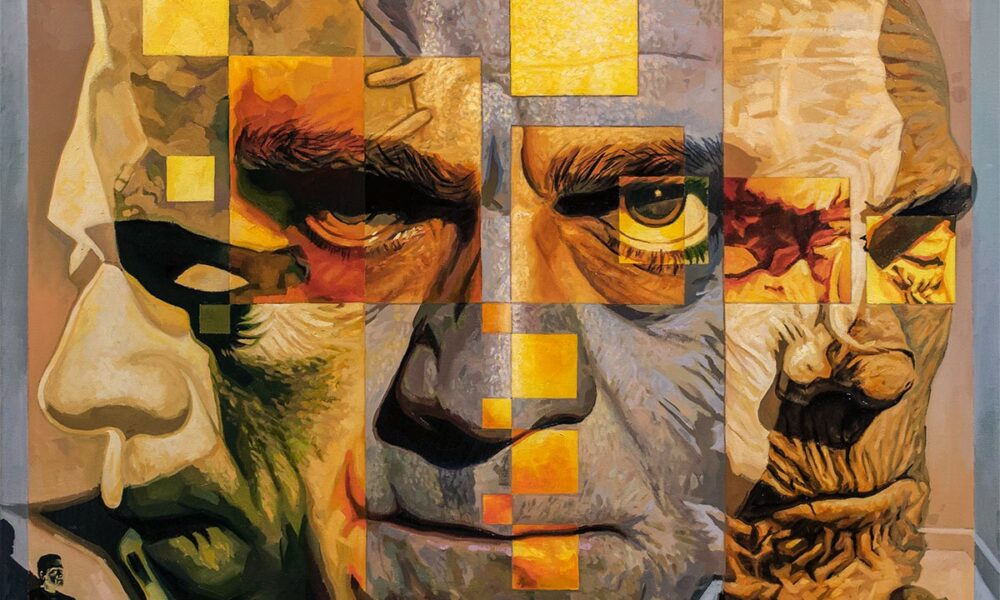
Without getting into a lengthy word-salad of how my work explores human perception through a meta-modernist exploration of both subject matter and the historical baggage that accompanies oil painting; I’ll just say that my paintings combine traditional oil painting with digital motifs and nostalgic overtones.
For me, oil painting is magical. It’s steeped in historical importance and people speak of it with a kind of reverence that borders on the religious; and rightfully so. Pigments were hard to come by, paint recipes were kept secret, blue was more expensive than gold, and there were a thousand and one rules that you had to follow lest your painting would disintegrate before your very eyes! Oil painting was more akin to alchemy than anything else.
These days, however, it is much, MUCH easier. Paint comes in tubes, and we no longer have to source pigments from gems, mummies, and beetles. The paint doesn’t fade, and there are more colors than ever before. Thanks to modern chemistry, we’ve thrown out most of the rules and modern paintings are more durable than ever before. We are living in the golden age of paint! Ironically, it was in the birthplace of the Renaissance when I had the revelation that would change my artwork forever.
Italy changed everything about art for me. I wasn’t satisfied with creating paintings that were beautiful for beauty’s sake; I wanted them to create paintings that impacted the viewer the same way I felt in Italy; to create a cognitive dissonance would allow the viewer to experience something outside their normal awareness.
Digital images berate our senses 24/7, and rarely do we spend more than a second looking at them as we scroll past. However, we will stare long and hard at an artwork in a gallery or museum; because it was created by a human hand and it conveys that human experience.
With the aid of the computer, I create a concept or “digital sketch” that I would then paint on canvas. By using the computer’s ability to layer, color, and distort images, I’m able to create compositions in the paintings that allow us to experience them more akin to how we recall a memory or experience: not as a single frame in a film, but as a juxtaposition of related images and elements that come together, overlap, and fade away. My paintings are, therefore, not merely seen but rather experienced.
My latest series of paintings have been exploring a concept called “anemoia”: a recently coined word that means ‘nostalgia for a time you’ve never experienced. To create these paintings, I seek out vintage photos, illustrations, and design motifs from the 1950s-1970s and combine them to create these liminal compositions that have a strange sense of modernity yet are comprised of nostalgic imagery in an alluring, yet slightly unsettling way. These paintings get different reactions from viewers depending on their age: older viewers see them as embodying the feeling of the particular era, while younger viewers experience the anemoia of the painting; like the ghost of a lost era gently whispering in their ear.
Let’s talk about our city – what do you love? What do you not love?
Minneapolis has a wonderful artistic community, and has been the jumping-off point for so many artists and creatives in numerous fields. We have some incredible art in the MiA, Walker, and the Weisman, as well as having the largest studio art crawl in the nation!
But while Minneapolis and Minnesota are supportive of the arts, there isn’t much opportunity for commercial success. Minneapolis doesn’t have the gallery scene that it fostered in the 1980s, and that gallery culture that continues in LA or New York’s Chelsea district doesn’t exist here anymore. Many of the collectors that live here tend to buy from galleries in Chicago, New York, and LA, and in a self-fulfilling prophecy, artists here have to sell in galleries in Chicago, New York, and LA.
In a way, Minneapolis is like a supportive family: they are proud of you, but you need to move away if you want to be successful.
Contact Info:
- Website:www.MatOllig.com
- Instagram: https://www.instagram.com/matollig